First Time Watches - April Top 10
Birds of Prey (1968), directed by Jose Giovanni.
The more movies I see starring Lino Ventura the more I think he may be my favorite movie actor. With a face like a Claw Hammer and the demeanor of a Mastiff (though he can be tender and funny, too), he plays everything so truthfully. A national treasure, he has a street named after him in Paris. In Birds of Prey, Ventura plays an assassin sent to Vera Cruz Mexico to kill a corrupt President. He begrudgingly takes a younger, far more idealistic assassin under his wing. It is wonderful to see Vera Cruz in the flesh, a location that should have been used more fruitfully over time. I was not that familiar with director Jose Giovanni, but I am impressed and will diving in deeper in due time.
Exit 8 (2025), directed by Genki Kawamura.
I have never played the video game that inspired this, nor do I play video games, but I quite enjoyed this impressively mounted mind fuck. A young man gets trapped in a series of dead ends in a Tokyo subway. He then begins to realize it is not only he that is in the Sartre-esque nightmare. There is something at the film's root, a fear of fatherhood, which for me gave it some substance beyond a rather thin and repetitive premise. The film is carried to a degree by its awesome sound design and score. And it has one of the most startling shock cuts of the year (warning, if you are freaked out by Rats, tread carefully).
Up to His Ears (1965), directed by Phillipe de Broca.
The third of five collaborations between direct de Broca and Jean-Paul Belmondo. This one is a trifle, really, a lark, but an expertly made one. In this loose adaptation of a novel by Jules Verne (Les Tribulations d'un Chinois en Chine), Belmondo plays a millionaire living on a yacht who is, nevertheless, depressed and suicidal, finding that life has no meaning. When he loses his fortune he gets a new lease on life and has a series of adventures born of his newfound poverty, some of them with the bespectacled and bewitching Ursula Andress. Andress plays against her sexpot image somewhat, here, and shows herself to a deft comedienne. And Belmondo is just one of a kind, doing a series of jaw-dropping stunts and make everything look cool and easy. When the Tom Cruise's of the world have built whole publicity campaigns around doing their own stunts, Belmondo says "hold my Beaujolais."
Los Olvidados (1950), directed by Luis Bunuel.
I had somehow managed to avoid Luis Bunuel's disheartening depiction of children in the festering slums of Mexico City until today. I guess I was afraid to be disheartened. I finally manned up. Damage done. Sympathetic without ever resorting to sentiment. In fact, Bunuel's decision to use largely amateur actors from the Mexico City neighborhood locations helps in this regard, as Bunuel was able to exert control in much the same manner as Bresson with his amateur actors. The look of bliss on the faces of some kinds who get a small slice of meat on their bread for dinner cannot be faked. That he coaxed these performances not only out of amateurs, but, for the most part, children, is one of the great achievements in cinema. The kids are, for the most part, a bunch of little shits, but Bunuel does not judge. In a rare moment (for Bunuel) of an outright statement of message, a sympathetic head of a work camp who takes one of our protagonists into to his institution says, "if only we could lock up poverty, and not children." Amen, hermano, amen.
Limite (1931), directed by Mario Peixoto.
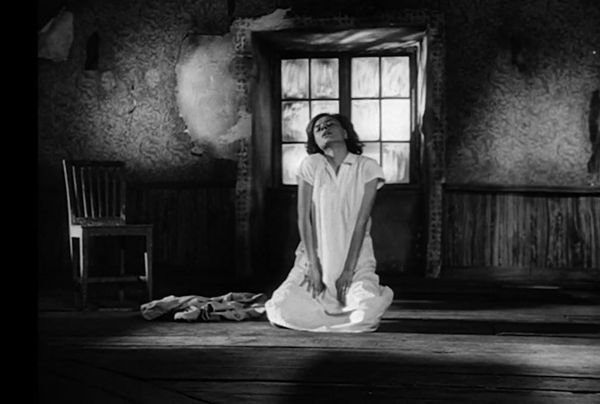
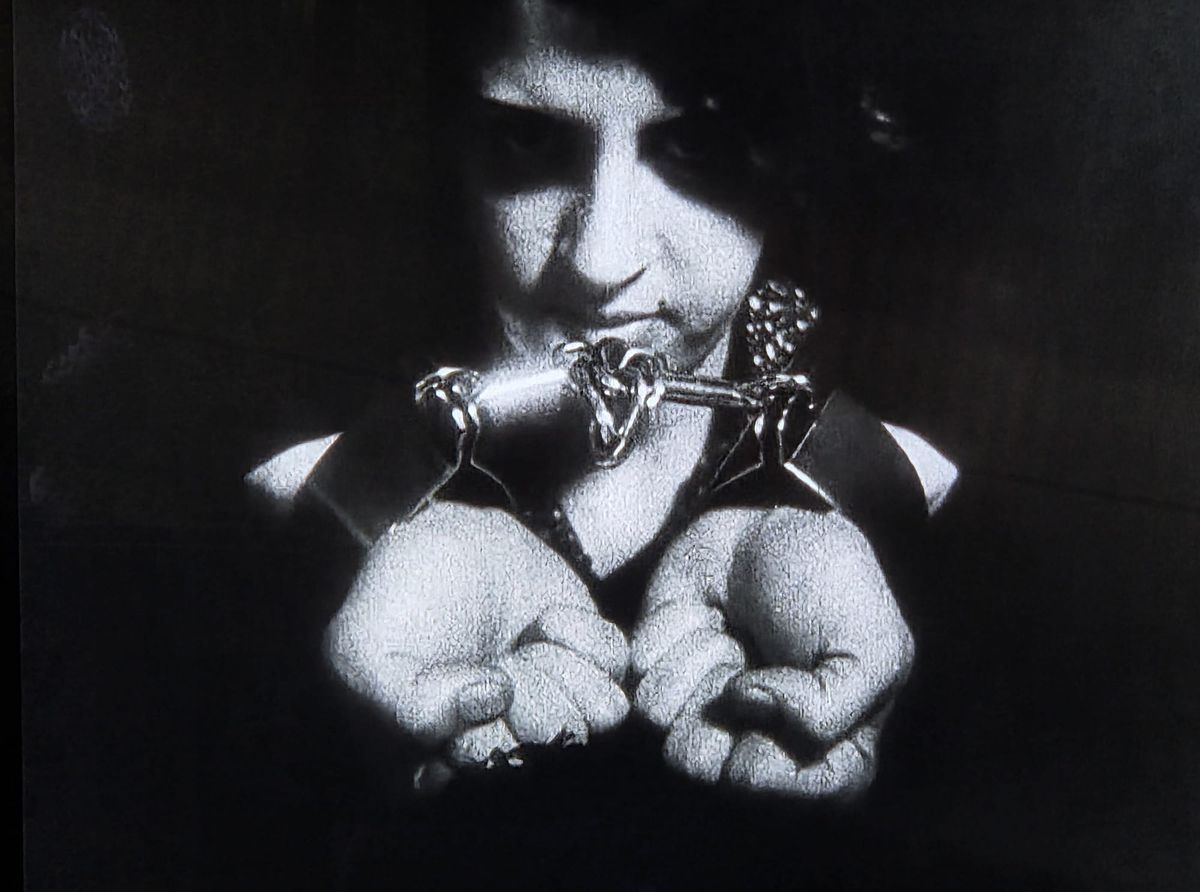
This long difficult to see 1931 film from the wunderkind director Mario Peixoto at the ripe age of 21 (he was sort of the Brazilian Jean Vigo)! Sadly, it would be his last film, though, unlike Vigo with his untimely early death, Peixoto just seems to have lost the interest. This silent abstract concerns three castaways on a boat who have a series of reveries about the past. Peixoto was obsessed with a picture in a magazine of a woman's face in the foreground with a pair of meaty man hands in handcuffs in the foreground. This shot is reproduced for the film's first and last shots (picture is above). The film deals with three castaways, two women and a men, and a series of flashbacks which recounts how they wind up there. Probably has something to do with the impossibility of the male-female relationship, but nothing quite so obvious is on display. A mysterious aural and visual experience. The musical score contains works by Satie, Debussy, Stravinsky, Prokofiev, etc. Long thought lost, restored by Martin Scorsese's Film Foundation, now on Criterion and Watch TCM, an absolute must see.
Berlin Express (1948), directed by Jacques Tourneur.
A difficult-to-find gem from beloved auteur Jacques Tourneur. Set amidst the ruins of WWII, and handful of passengers on a train become involved in an assassination plot. God I love train movies, with characters wobbling back and forth in tight quarters. And I love Robert Ryan, who reminds me of my grandpa, John Queen.
The Horsemen (1971), directed by John Frankenheimer.
In keeping with the theme for the month, this Frankenheimer film has been difficult to find. I even resorted to buying a dvd in Dublin in a format I thought would work on my all region player, but, alas, no go. Fortunately it showed up on Tubi very briefly, only to be taken down shortly I after I caught up with it. It is considered minor Frankenheimer, but I found it fascinating. It focuses on the sport of buzkashi, the Afghan sport which is essentially men on horseback in competition to see whom can grab a fleeing goat. Omar Shariff plays one of the participants, who seems to use the sport and his success with it as a way of pleasing his intransigent father, the Master of Stables, played by Jack Palance. The lengthy buzkashi sequence is a tour de force, up there with anything Frankeheimer has ever mounted. While it is jarring to see Palance as Shariff's father, and a rather unnecessary romantic subplot is wedged in featuring the uninspiring Leigh Taylor-Young, the film works as a critique of machismo while still being a thoroughly macho. Shariff, pretty and delicate as he always was, is perfectly cast as the over-reaching, father-pleasing protagonist. Screenplay by Dalton Trumbo and score by Georges Delerue. First class all the way. I wonder why it has been forgotten to time?
Take Aim at the Police Van (1960), directed by Seijun Suzuki.
I am coming around to Suzuki. Branded to Kill always struck me as overrated, a willful attempt to create a hyper-stylized hipster classic. But catching up to Suzuki via Criterion channel's Japanese Noir collection has been an eye opener. This one, a policier with, of all things, a Police Van driver as its tough-guy protagonist, is terrific. The brilliantly staged opening sequence, which appears to be a prison break (gunmen poised to take out the titular police van) turns out to be an assassination, instead. The driver of the van is suspended for 6 months, which he takes as an opportunity to solve the crime. Suzuki shows himself here to be a more-than-competent classicist. If you find yourself intimidated, wondering where to start, with the Criterion collection, this is as good a place as any.
Big City (1937), directed by Frank Borzage.
TCM graced us with a bunch of Frank Borzage films on his birthday, many of them I hadn't seen. This was my favorite, a glorious paean to the Brotherhood of New York hacks. Spencer Tracy stars as Joe, a cabbie who enlists his hack brethren to help his pregnant wife (Louise Rainier) not get deported. As with all of the best Borzage, it manages to mix sometimes silly comedy with deeply moving scenes celebrating love (with a capital L), loyalty and a darkness that must be overcome. Tracy and Rainier make an interesting pair in that each of them won back to back Best Actor/Actress Oscars, both in 1937 and 1938, but neither for this film. The German Rainier was a pretty big deal at this time but, to be honest, she is a ham. Yet there is something exquisite about her, with those giant doe eyes always on the verge of bursting into tears. Tracy, on the other hand, makes you believe he would do anything for his woman. He was always at his best playing a flawed palooka. While the film uses its share of backdrops, it also has an unusual amount of exterior real-location filming, and 1937 New York looks amazing as the Cabbies zip around.
Project Hail Mary (2026), directed by Lord and Miller.
Okay, I got sucked in and I am a sucker, but we need Popcorn movies. It's smart, grave without being Marvel-pretentious, and proves once again that Ryan Gosling is our best movie start. It is twenty minutes too long and pulls a little too aggressively at the heartstrings, especially in Act 3, but come on, let's yourself go, you grouch.