The American Cinema Now
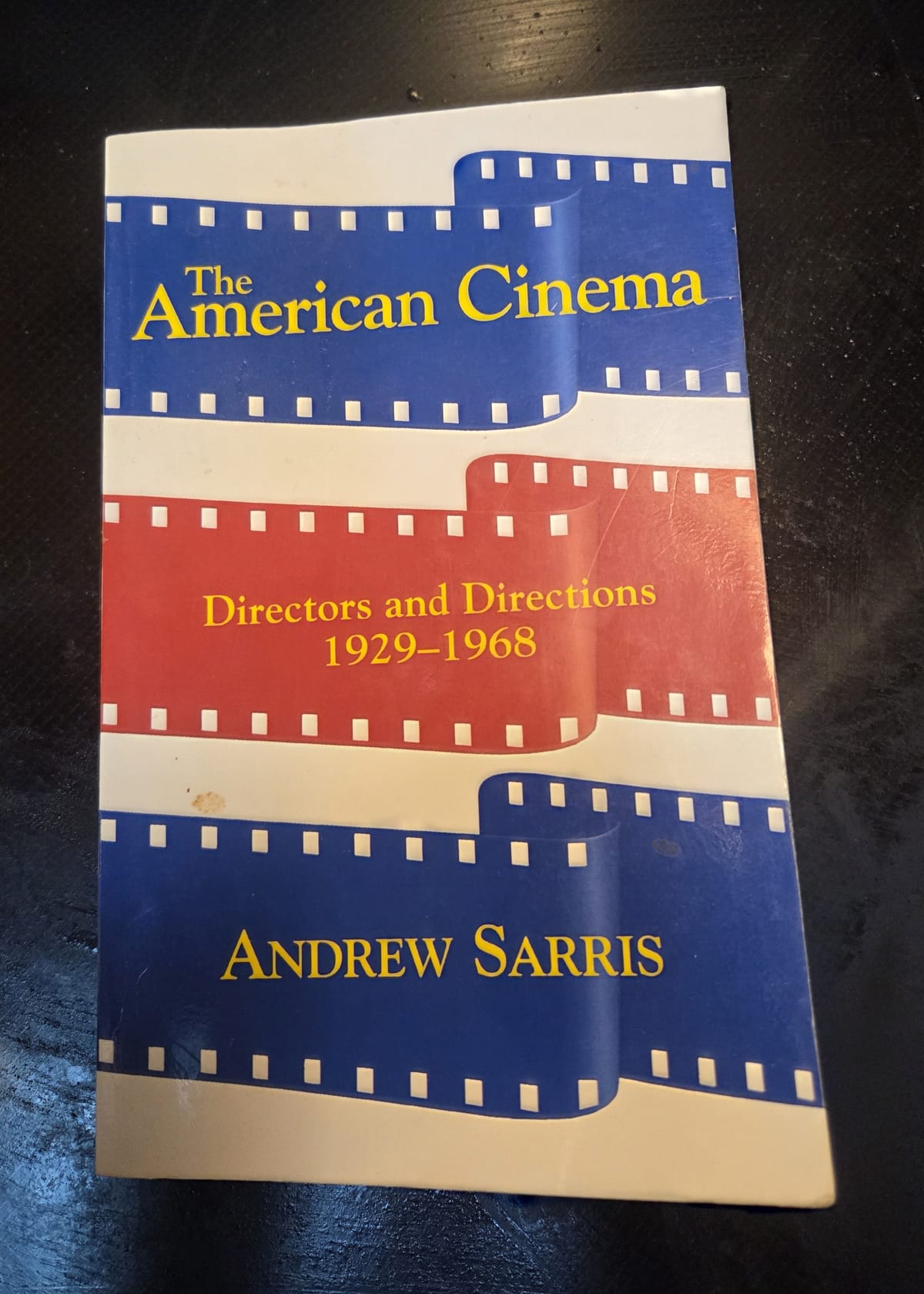
About a year and a half ago, I started what would prove to be an unachievable and utterly batshit project. It was a "revision" of the Andrew Sarris seminal text The American Cinema: Directors and Directions 1929-1968, or as it is more commonly known, that one book about the Auteur Theory with all of those wacky categories.
Sarris first got his hooks in me in 1980, when I was 19. A few years before I had an inciting incident of stumbling upon Strangers on a Train on late night t.v. and became aware of a sensibility that was beyond acting (though the the acting was great) and the screenplay (though the screenplay was great), an abiding presence, an overarching style. I suspect Hitchcock was the gateway drug for many a budding auteurist, and I dove into what I could find to read about him, including Truffaut/Hitchcock, which was inexplicably available at my local library. I began to understand what the director did and how they could impose their will upon the finished work.
In the fall of '80, at the The Evergreen State College in Olympia, they had a terrific film screening program, curated almost solely on auteurist principles, and the programmer talked about Sarris all the time. I plunged into The American Cinema, and I was a goner.
I am hard-pressed to say exactly what is about auteurism that ensnared me. No doubt there was an aspect of elitism in it, a draw for a pretentious little shit like me. We know the truth about Blake Edwards, and you don't. But the real appeal of the categories is it created an organizing principle for film viewing. I was eager to gobble up everything I could, but I couldn't see everything, so the categories gave me a reference point for selection I use to this day.
Those categories have haunted cinephiles for 57-odd Years now. I am sure I was not alone in imagining how they could be applied to the cinema of today. Finding myself with time on my hands and some mild insomnia, I began this foolish endeavor. My aim was to take up more or less where Sarris left off (1968) and revise the categories for active film directors in the modern age.
The project proved to be unwieldly, a perpetually moving target and a cause of much fear and loathing for me as I tried to distinguish between Strained Seriousness and Less Than Meets the Eye. And who as I, anyway, to be making these judgements? I mean, he was Andrew Sarris for Chrissakes. But me? Yeah, no.
Additionally, the very nature of the Movie Director has changed so radically since Sarris' radical work. Then it was a celebration of the unjustly maligned and ignored, a line in the sand proclaiming the director as an artist on par with the Poet, the Composer, the Novelist. And to celebrate the American director, heretofore that disreputable hack figure, first and foremost, something that was only being done abroad, and barely there (mostly France), at the time. However, today, in no small part owed to work of Sarris and his followers, everyone is an auteurist, so much so that the very nature of the word, and the theory, as been been utterly bastardized.
But despite these reservations I plowed on. Categorize I must, and did, and it seemed a shame to keep all that work hiding on my hard drive. So what follows is that work in progress, minus much of what made the Sarris so entertaining (the erudite and sometimes bitchy blurbs on the directors – I have attempted some of these, embedded in certain entries, where I felt so inspired or needing the justify the categorization). I have done my best to keep the categories, and their descriptions (included at the beginning of each entry) truthful to the original text. I have also tried to keep the listed filmographies as accurate as possible but I, like you, am a slave to imdb and Wikipedia, so be gentle.
The most difficult aspect of this was the filmographies and the very nature of the shifting of what we call "the present." Masterpieces from the Pantheon and negligible garbage from the lower depths continue to be churned out even as I tried to create a meaningful timeline. Even as I type, in fact. I cannot say that any category significantly changed in the time that has passed since I began and now (whatever "now" means). If anything, I feel the categories have become more justified.
A few things to keep in mind:
--This was not a moral exercise, so you may seem names canonized that you find otherwise objectionable. Not relevant here.
--American films only, but they can be American films made by non-Americans.
--T.V. work, definitely a THING now while not at all the case at the time of the Sarris, is excluded. Filmographies and categories take into account theatrical releases only.
--Directors largely focused on documentaries for their career are excluded, not because Errol Morris or Frederick Wiseman don't belong in the Pantheon, it is just a different Pantheon.
--Films made from 1968 on. Category rankings do not take into account anything from the filmographies prior to 1968.
--Notable works from the filmography are italicized, as Sarris did.
--If a director was ranked in the original Sarris text, I make note of it in the individual entry. This proved to be pretty interesting as categories changed quite often as the filmographies deepened (e.g. Kubrick and Cassavetes). We can guess from Sarris' critical work after 1968 where some of these may have been re-classified, but he never bothered to do, nor should he.
--I have attempted to present the categories in the order in which they appear in the book.
--There were some categories that simply were not going to work for this revision. "Make Way for the Clowns" for instance, was Sarris' attempt to bestow auteur status on movie comedians who had a far stronger impact on their movies than there often hired-hand directors (W.C. Fields is probably the best example of this). This is a concept that has been largely lost in the modern cinema. "Subjects for Further Research" became tricky as well. Sarris used it to discuss directors about whom little was known due the difficulty of film scholarship in the olden days. That didn't really apply now, so I used the category to capture directors who don't have a body of work ample enough to categorize. Again, however, this has proved problematic because those bodies of work are growing as we speak, so there may be some names in this category that, well, deserve further research.
Hopefully, this is close enough to a start. At least now I can sleep.
Chapters:
The Far Side of Paradise
Expressive Esoterica
Fringe Benefits
Less Than Meets the Eye
Lightly Likable
Strained Seriousness
Oddities, One-Shots and Newcomers
Subjects for Further Research
Miscellany