Two-fer Tuesday - June 16
Every Tuesday Big Heads will "program" a double feature of similar (thematically, visually, spiritually) films. I will provide Just Watch links so you can track down where to stream them and turn your house into a got-dang Cinematheque.
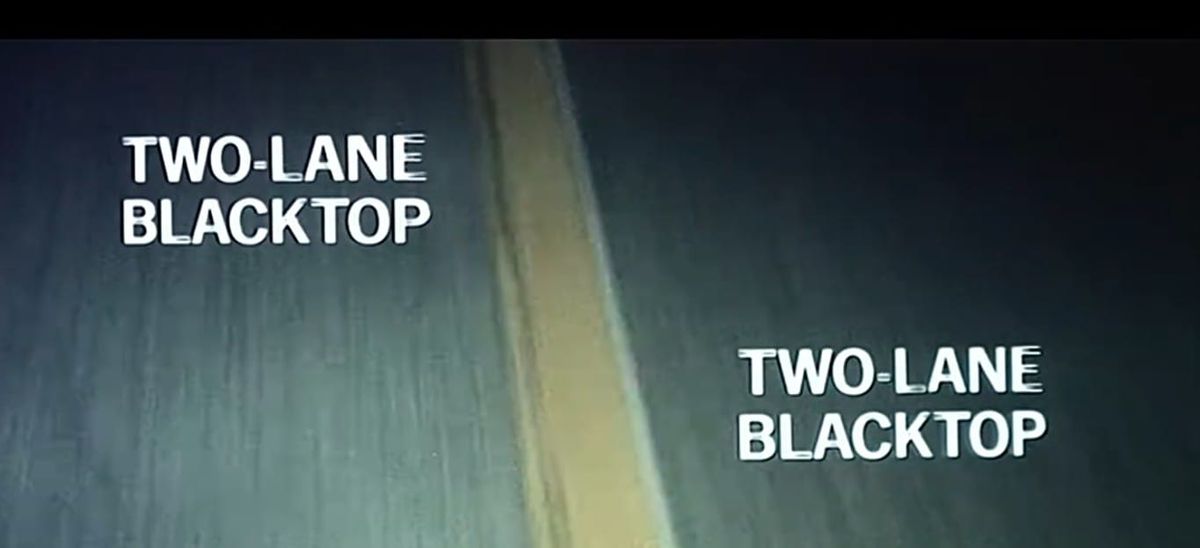
This Tuesday we present two gearhead-centric classics from 1971, Monte Hellman's Two-Lane Blacktop and Richard C. Sarafian's Vanishing Point.
Both films, in different ways, deal with counter-culture and rejection of authority. Two-Lane is the far more elliptical and subtle, our two protagonists, played by non-actors James Taylor and the Beach Boys' Dennis Wilson (and when I say non-actors, I really mean it) may be lost souls, but nobody talks about how lost they are or why. The fact they live on the fringes of society, street racing their souped-up '55 Chevy 150 for pink slips (and have no particular other purpose or vocation) is enough to understand that this is the weird, forgotten America.
The film really starts to cook when they meet an adversary who becomes obsessed with winning the Chevy. GTO, played in what is one of the great American performances by Warren Oats, is named GTO because he drives a GTO. A man is his car. Speed is the key. No looking back.
To its credit, Two-Lane Blacktop doesn't spend any time talking about what the boys are running from. They just run. Vanishing Point is far more explicit in its anti-authoritarianism. In this one the driver, also obliquely named Kowalski (great pains are taken to never slap a first name on him), is delivering a 1970 White Dodge Challenger to San Francisco. He resists arrest, for no particular reason provided, then spends the rest of movie in pursuit by Blue Meanies (as the cops are referred to). His journey is narrated by a mysterious D.J. Super Soul (Cleavon Little), who has access to the police frequency, and he becomes a folk hero.
It is a little odd our anti-hero hero is played by a handsome Jewish guy (Barry Newman), an ex-cop and Vietnam Vet, no less, while a black man narrates as if at his service (1971 is also the year of Melvin Van Peebles Sweet Sweetback, which serves as a far more subversive flip side to Vanishing Point, a man-on-the-run movie with a true black outsider at it's center). Kowalski fends off the advances of numerous willowy and subservient white women, including the startlingly beautiful Charlotte Rampling in a weird cameo. No time for lovin', ladies, just gotta drive.
Vanishing Point's occasional silliness and incorrectness does not hamper the set pieces, beautifully shot by a young John Alonzo. The car chases are the movie, really, and they remain iconic. Keep an eye out for a cameo appearance by the "Texas Dip," the undulating strip of Highway 78 in Borrego Springs that plays a key role in the chase scene in One Battle After Another. Vanishing Point, unlike the mostly nocturnal Two-Lane Blacktop, is an homage to the American West in all its brightened glory.
I will contend Two-Lane Blacktop is a masterpiece, but it is difficult to convey why in a verbal critique and explication of plot. Hellman (and screenwriter Rudy Wurlitzer) imbues the film with a despair that is hard to shake. To watch it is akin to being left alone along one of its highways in the dark, wondering which way to head next. Vanishing Point is more of a cult object (one that gearheads have not gotten enough of for 55 years), whose heavy-handed approach to its themes ultimately hurts it. Two-Lane Blacktop is 4th in my Directorial Chronology of 1971. Vanishing Point is 40th.