TCM Look-Ahead - October 2
A weekly feature here on Big Heads that looks forward to the week ahead on the mighty Turner Classic Movies. For your viewing and recording pleasure.
Friday, October 2
02:15 p.m. PDT Look Back in Anger (1959) The first of the British Kitchen Sink, Angry Young Man films notable more, for me at least anyway, as a reminder of the incredible power of Richard Burton, the actor. Mostly wasted on pay check parts in movies and tabloid marriages in life, he explodes here with the force of a thousand suns. What could have been. Tony Richardson directs the Paul Osborne adaptation of his own play.
Despite every golden impurity, Richardson's film is somewhat of a spell-binder, thanks mostly to its solid pictorial "memories" of the archaic Warner Brothers clutter style... [the film] bulges with a good deal of marred but interesting visual detail. – Manny Farber
Saturday, October 3
A tribute to the great Lon Chaney today, including...
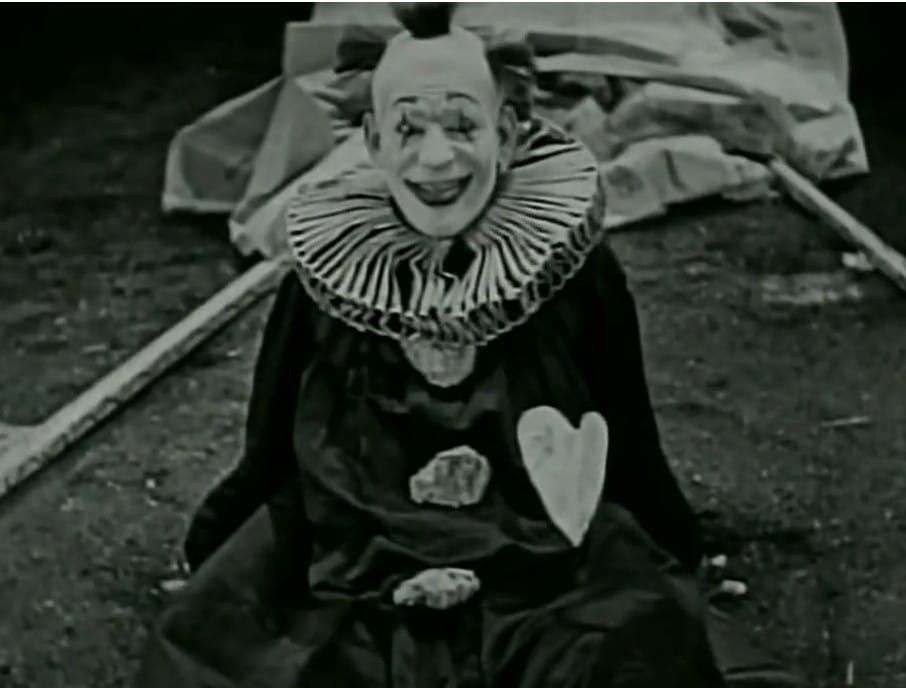
01:30 a.m. PDT He Who Gets Slapped (1924) Trigger warning. If, like Cosmo Kramer, you are afraid of Clowns, this one may send you screaming into the night. For me, the place to start if cracking open Lon Chaney. All the trademarks are there – the reliance on (sometimes grotesque) costume and makeup, the wild hammery, the pathos and yet, always, the earned sympathy. The film was directed by the great Swede Victor Sjostrom (The Wind, The Phantom Carriage), no slouch.
Despite the obvious poetic touches—a clown who pops up in interstitial scenes, spinning a globe and cackling about the fate of the little people—this is still the kind of movie where a score is settled by unceremoniously unleashing a man-eating lion in a confined space. It is gleeful, soulful trash of the very highest order. – Kyle Westfall, MUBI
06:15 a.m. PDT Village of the Damned (1960) The first of a series of films about weird, possessed children with unearthly staring eyes. It is not to be confused with Joseph Losey's similar and superior These Are the Damned (1961), but it is pretty great. Based on the classic novel The Midwich Cuckoos by John Wyndham (Day of the Triffids). A town's women-folk start birthing babies after a mysterious event with whom something is definitely not right. The film's success spawned a sequel, Children of the Damned (also not to be confused with the Losey), and a pretty terrible remake by John Carpenter (not to be confused with Joseph Losey) in 1995 starring Christopher Reeve.
One of those little science fiction movies that, once seen (and it's a TV staple) is never forgotten. – Kim Newman
Sunday, October 4
08:00 p.m. PDT All the President's Men (1976) This great American Classic doesn't need me to recommend it, but it is nice to have the occasional reminder of what "Great American Classic" means: expertly cast, precise and not showy direction (Pakula), perfectly crafted screenplay (Goldman), about the most important things in the world (the necessity of a Free Press in a healthy republic – remember that?), almost eerily prescient, suspenseful, funny, with real-life, world-reverberating stakes. Astonishing masterpiece.
All the President's Men is a quintessential American movie: It does a lot of things well and makes it all look simple. It works on several levels. – Joseph Gelmis
10:30 p.m. PDT The Manchurian Candidate (1962) An apt partner in a double bill with All the President's Men because while the former posits a world in which dogged pursuit of truth and justice will ultimately be rewarded, Manchurian basically posits "what's the use?" The corruption is deeper than you can possibly know. John Frankenheimer's adaptation of the Richard Condon novel suffers from an overweening style and questionable casting (neither Frank Sinatra nor Lawrence Harvey seem quite right in their roles) but, this many years, conspiracy theories, assassinations both fake and real later, it is an indelible document of paranoia and hopelessness. In other words, a great time to be had for all! "Raymond Shaw is the kindest, bravest, warmest, most wonderful human being I've ever known in my life"
Powerful experience, alternately corrosive with dark parodic humor, suspenseful, moving, and terrifying. – Jonathan Rosenbaum
Monday, October 5
04:00 a.m. PDT Three Colors (White) (1994) The most lighthearted, least pretentious of the Trois Colours trilogy by Krzysztof Kieślowski, but it still has bite, driven by the Kieslowski themes of murder, suicide and revenge. Karol Karol is a Polish immigrant living the dream in Paris until his "out of his league" wife (the wonderful Julie Delpy) dumps him and he seeks comeuppance. You will find yourself rooting for this pint-sized everyman, all whilst wondering if there is not a strain of misogyny running through the film.
How could the creator of Blue, the story of a woman who grieves by moping around Paris in a chichi haircut, possibly have followed it with such a rich, light-handed marvel? – Caryn White
Tuesday, October 6
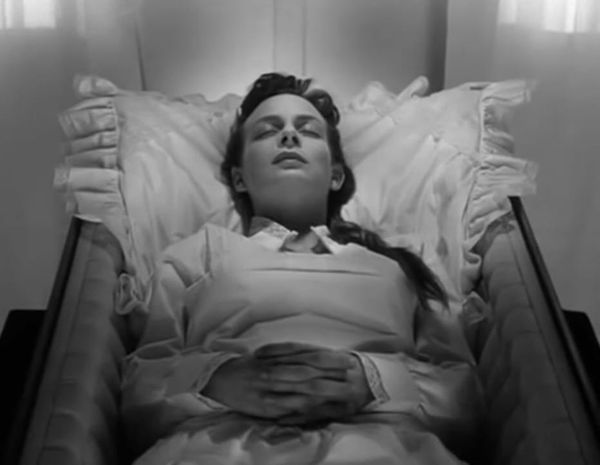
08:00 p.m. PDT And Then There Were None (1945) A well-above-average Agatha Christie adaptation by Rene Clair, his last really satisfying American film. A dream cast that includes Walter Huston, Barry Fitzgerald and Judith Anderson (Mrs. Danvers from Rebecca), go through the paces and slowly get knocked off, one by one. A cozy watch for a rainy afternoon.
The film cleverly balanced its high body count with a refreshing, bloodless, and witty presentation. – Bosley Crowther
Wednesday, October 7
01:00 a.m. PDT Suspicion (1941) Hitchcock wanted a far darker ending than what he was allowed, but this is still a trademark-tight Gaslighting drama that may or may not be about a woman whose "out of her league" husband is trying to kill her. The shot of Cary Grant (will he or won't he?) walking up the stairs with a glass of suspiciously glowing milk is one of Hitch's best. The Oscar winning role for Joan Fontaine.
Everyone concedes that this 1941 Hitchcock film is a failure, yet it displays so much artistic seriousness that I find its failure utterly mysterious. – Dave Kehr
Thursday, October 8
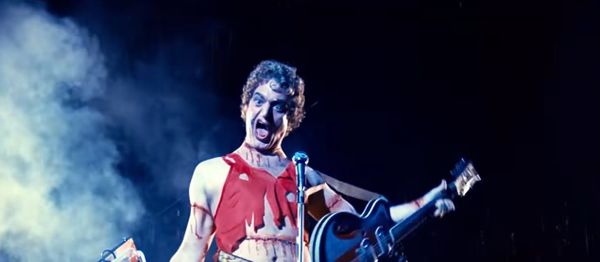
Midnight PST The Howling (1981) The somehow underrated auteur Joe Dante made. arguably, the best sequel ever (Gremlins 2, the New Batch), the best werewolf movie (The Howling), the best "film about film" (Matinee) and the best animated feature (Small Soldiers). Oh, and while we're at it, he also made, made the one of the best t.v. movies (The Second Civil War). The Howling was the first of the revisionist Werewolf pictures, beating Landis' American Werewolf in London to the box office by a few months. Both are great, I slightly prefer the Dante for its craft, its comparatively light touch and for Dee Wallace.
It's a superior entertainment as creepy, witty, and suggestive as its disreputable genre would warrant.– J. Hoberman
08:00 p.m. PST They Shoot Horses, Don't They? (1969) They dance endlessly in circles and get nowhere. Sydney Pollack was, on the hole, a crowd-pleaser, but he let it fly with this Horace McCoy adaptation that remains one of the great documents of the Depression. Jane Fonda demonstrated once and for all she was an actress of the highest order in her portrait of Gloria Beatty, who enters a dance marathon the scrape up a few bucks to continue her meager existence. The other marathon participants (including Bruce Dern, Bonnie Bedelia and Red Buttons in a surprisingly heartbreaking turn) are a snapshot of American desperation, and the emcee (Gig Young, who won the Best Supporting Actor Oscar) is a symbol of the capitalist swine overseeing the sorry spectacle with oily charm and caustic asides. Michael Sarrazin is the film's weak link as Gloria's dance partner, but you can't blame the guy, trying as he must to keep up with the unstoppable force that is Fonda.
Two people, male and female, circling endlessly around a dance floor, the girl, tough and scared and vulnerable, spitting out “Christ” as an epithet at every new evidence that God did not exist.– Andrew Sarris
Friday, October 9
11:00 a.m. PDT Mon Oncle (1958) Probably the most accessible, sentimental and typical of the films of the great Jacques Tati, it is certainly the one, with its Academy Award for best foreign film, that put him on the world's map. If I prefer Playtime (for its astonishing formal experiments) or Monsieur Hulot's Holiday (for its first fully realized fleshing out of Hulot as the modern-day equivalent of Chaplin/Keaton) it does not diminish the irresistible charm of Hulot who, on a visit to his sister and brother-in-law in their hilariously modern house, wrecks havoc in a series of masterful set pieces. The house itself is a character, as is a pack of stray dogs that run through the sets and sequences and serve as a symbol of the triumphant outsider. Like Hulot himself.
It is not a comedy of gags or funny lines (the only kinds of comedy left in Hollywood); here tragedy and comedy go together, enriching each other, contrasting and balancing between laughter and tears. – Jonas Mekas