Underrated Auteurs - Andre de Toth
I use the term "Underrated Auteur" frequently on the TCM Look-Ahead column. These are the less ballyhooed names from Hollywood history who nevertheless can rightly be classified as auteurs, with long, generally successful careers within the restrictions of the Hollywood system, yet managed to make distinct, personal films despite those restrictions. These are not names from Andrew Sarris' upper echelon categories. In fact, in some cases they were left out of the Sarris text altogether or were, and I say this respectfully, egregiously mis-categorized.
The focus will be on directors from early Hollywood since that is the focus of the TCM column, but will also take a look at some more contemporary names that have fallen through the cracks. So, without further ado, here are the Underrated Auteurs.
Andre de Toth (1913 - 2002) Notable films in italics.
Wedding in Toprin (1939), The Five-Forty (1939), Two Girls on the Street (1939), Six Weeks of Happiness (1939), Semmelweis (1940), Passport to Suez (1943), None Shall Escape (1944), Dark Waters (1944), Ramrod (1947), The Other Love (1947), Pitfall (1948), Slattery's Hurricane (1949), Man in the Saddle (1951), Carson City (1952), Springfield Rifle (1952), Last of the Comanches (1953), House of Wax (1953), The Stranger Wore a Gun (1953), Thunder Over the Plains (1953), Crime Wave (1954), Tanganyika (1954), Riding Shotgun (1954), The Bounty Hunter (1954), The Indian Fighter (1955), Hidden Fear (1957), Monkey on My Back (1957), The Two-Headed Spy (1958), Day of the Outlaw (1959), Man on a String (1960), Morgan, the Pirate (1960), The Mongols (1961), Gold for the Caesars (1963), Play Dirty (1968).
If one wanted to conjure the perfect image of the Film Director, Andre de Toth, with his marvelous eye patch and stern Hungarian visage, would do quite nicely. After spending his professional youth in the thriving theatrical scene of Budapest, where he spent some time being mentored by Molnar, De Toth began his film directorial career in Budapest with a series of films that remain lost to time. He migrated first to England, where he worked for Alexander Korda, then eventually settled in Los Angeles.
He lost sight in his left eye at an early age, and sported an eye-patch that once got him mistaken for Moyshe Dayan and almost assassinated. He was married seven times, including to, lucky boy, Veronica Lake. You can't make this stuff up.
Like his more celebrated contemporary, Anthony Mann, de Toth moved seamlessly between noirs and westerns. His noirs (Pitfall, Hidden Fear and Crime Wave probably being the most distinguished) are amongst the most spare, uncompromising and misanthropic of a genre distinguished by those traits. His Westerns (with Ramrod and Springfield Rifle standing out), predictably, avoided tired tropes and explored the darker edges of troubled anti-heroes.
His best-known film is probably House of Wax (1953), the first theatrical release in the 3D process. The film holds up remarkably well with our without the 3D, and features arguably Vincent Price's best performance.
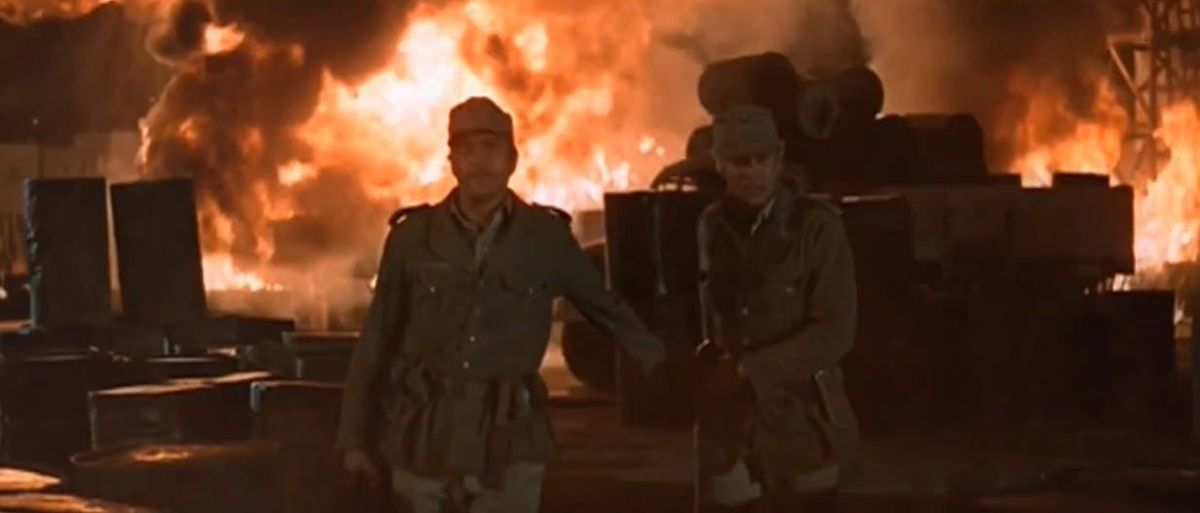
As with Mann and others struggling to find work late in life, his late career took a turn to Italy, where he made a series of rather unremarkable films. When he returned to England and America he served as second unit director on more distinguished films (including Lawrence of Arabia and the Donner Superman). Not satisfied with playing second fiddle, he concluded his directorial career with the mighty Play Dirty (1969), one of the great swan songs in cinema, a spare, uncompromising and misanthropic war film. In other words, a de Toth.
Andre de Toth was properly categorized by Andrew Sarris in "Expressive Esoterica," but remains an Underrated Auteur.